Signs of a Serious Rat Infestation in Augusta Homes
Most Augusta homeowners who call us say some version of the same thing: "I think I might have a rat problem, but I'm not sure how bad it is." Severity determines the scope of treatment, the likelihood that a single visit resolves the issue, and the probability that structural damage has already occurred. Here is how to read the evidence and assess where on the severity scale your situation falls.
Droppings — The Primary Evidence Source
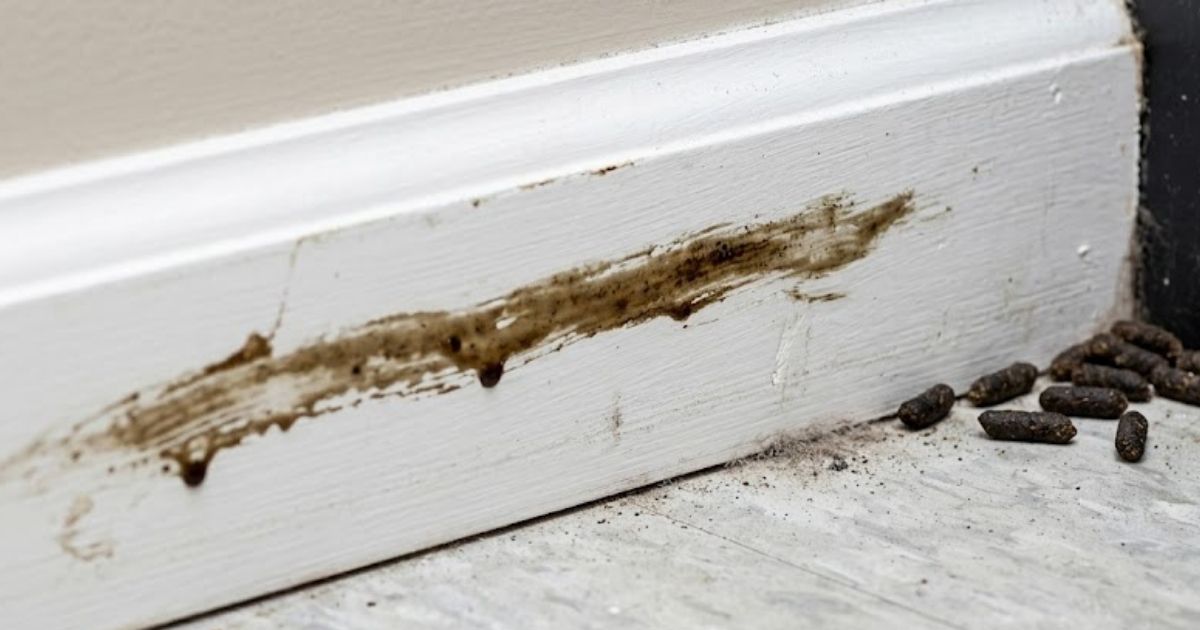
Norway rat droppings: ¾ inch long, capsule-shaped with blunt ends, dark brown to black. Found at ground level — along foundation walls, in cabinet bases, near food storage.
Roof rat droppings: ½ inch, banana-shaped with tapered ends, dark. Found at height — along attic rafters, inside soffits, in wall voids accessed from above.
House mouse droppings: ¼ inch, pointed at one or both ends, scattered broadly along travel paths rather than concentrated in one area.
Freshness matters: dark, moist, and soft means active infestation in the last 24–48 hours. Grey, dry, and crumbling means historical. Quantity is the severity indicator. Dozens of droppings distributed across multiple areas indicates an established colony that has been present for weeks or months.
Grease Trails and Rub Marks
Rats have oily fur and travel the same routes repeatedly, depositing a dark grease smear on surfaces they brush against. Grease trails along baseboards, pipe runs, or beams are among the most reliable indicators of an established, active infestation. Light travel routes produce no visible grease; heavy rub marks indicate a high-traffic path used by many individuals over time. This evidence is not present in new or minor infestations.
Gnaw Marks
Fresh gnaw marks are pale or cream-colored with rough edges. Old gnaw marks have darkened to match the surrounding surface. Finding gnaw marks on electrical wiring insulation is a specific alert — this is how rodent-related residential fires start, and it requires prompt professional attention.
Gnawed wiring in Augusta attics: Roof rats gnaw wiring insulation commonly. The NFPA documents rodent gnawing as a leading cause of unknown-origin residential fires. If your attic inspection reveals gnawed wiring alongside rat evidence, electrical inspection is warranted as part of the remediation scope.
Audible Activity
Scratching and scurrying in the ceiling at night — particularly between 11 PM and 3 AM — are roof rats in the attic. By the time an attic infestation is audible to multiple family members regularly, the colony is typically well-established.
When It Has Become a Major Infestation
Indicators that you are dealing with a major situation:
- Fresh droppings distributed across multiple rooms or locations
- Visible grease trails along multiple travel routes
- Audible activity heard by multiple family members regularly
- Detectable odor from the living area
- Any visual sighting of rats during daytime hours (daytime sightings usually mean a colony large enough that competition for nocturnal foraging space is pushing lower-ranked individuals into daylight activity)
Professional Severity Assessment — Same Day Available
Not sure how serious your situation is? We assess on-site and tell you honestly.
📞 Call (844) 635-0403Severity Assessment Scale for Augusta Homeowners
Rat infestation severity isn't a single threshold — it's a scale, and where your situation sits on the scale determines the appropriate response. The framework below helps homeowners self-assess before deciding on DIY versus professional intervention. The categories are diagnostic, not subjective.
| Severity | Diagnostic Signs | Population Estimate | Appropriate Response |
|---|---|---|---|
| Stage 1 — Recent intrusion | Droppings in 1 location only; no audible activity; no nesting evidence; single fresh sighting possible | 1-3 rats | DIY trapping + targeted entry-point sealing; resolve in 2-4 weeks |
| Stage 2 — Early colony | Droppings in 2-3 zones; occasional scratching sounds; gnaw marks present; possible nesting starting | 4-12 rats | Professional single-visit + targeted exclusion; resolve in 4-6 weeks |
| Stage 3 — Established colony | Droppings throughout property; consistent audible activity; visible nests; structural damage beginning; multiple sightings | 12-30 rats | Comprehensive removal + exclusion + cleanup; resolve in 6-10 weeks |
| Stage 4 — Mature infestation | Heavy droppings widespread; constant audible activity; visible damage to insulation, wiring; strong odor; rats observed during daylight | 30-100+ rats | Comprehensive scope plus likely insulation replacement and electrical inspection; resolve in 8-16 weeks |
The single most useful diagnostic signal is daylight rat activity. Rats are nocturnal by preference; daylight sightings happen only when population pressure forces individuals out during competing-for-resources situations. Daylight sightings reliably indicate Stage 3 or higher.
Why Severity Affects Treatment Cost More Than Property Size
Most Augusta homeowners assume property size drives treatment cost — larger home, larger cost. The actual driver is infestation severity, often more than square footage. A 1,200-square-foot home with Stage 4 severity costs more to treat than a 3,000-square-foot home with Stage 1 severity. The reason: Stage 4 work involves cleanup, decontamination, often insulation replacement, and follow-up scope that Stage 1 work doesn't.
The implication for Augusta homeowners: catching infestations early is significantly cheaper than treating late-stage infestations comprehensively. A Stage 1 situation that gets DIY treatment plus targeted professional exclusion runs $400-900 total. The same property at Stage 4 — having ignored the situation for 6+ months — runs $2,500-8,500 in comprehensive scope plus cleanup. The math is straightforward.
For Augusta homeowners uncertain about which stage their situation occupies, professional inspection produces a documented assessment that homeowners can use to evaluate treatment scope and pricing. The inspection cost ($150-275 typical) is recoverable if you proceed with treatment and provides accurate scope documentation either way. Inspection without commitment to treatment is a legitimate service rather than a sales-driven loss leader.
Augusta Property Types and Severity Trajectories
Different Augusta property types reach different severity stages at different speeds. Properties in older canopy neighborhoods like Summerville and Forest Hills often have roof rat activity that accelerates from Stage 1 to Stage 3 in 8-12 weeks because the structural conditions support rapid colony expansion. Properties in newer construction in Martinez or Evans typically progress more slowly because tighter baseline construction limits colony expansion rates. Knowing which trajectory your property follows informs how quickly you need to respond to early-stage activity.
What to Do at First Signs
For Augusta homeowners noticing early-stage signs — occasional droppings in one area, single nighttime scratching sound, faint odor that comes and goes — the practical response depends on how recent the activity appears and how confident the identification is. Truly fresh signs (droppings still pliable, sounds heard within the last 3-5 days) suggest Stage 1 conditions where DIY response is reasonable. Older signs (gray crumbly droppings, sounds that have been present for weeks) suggest later stages requiring professional response.
The mistake we see most often is homeowners who notice signs for weeks, attempt DIY response, achieve partial reduction, and assume the situation is resolving when it's actually progressing. Quiet periods during DIY response often represent population shifts rather than reduction. The diagnostic that matters isn't whether activity is currently visible — it's whether the underlying structural and pressure conditions have been addressed.