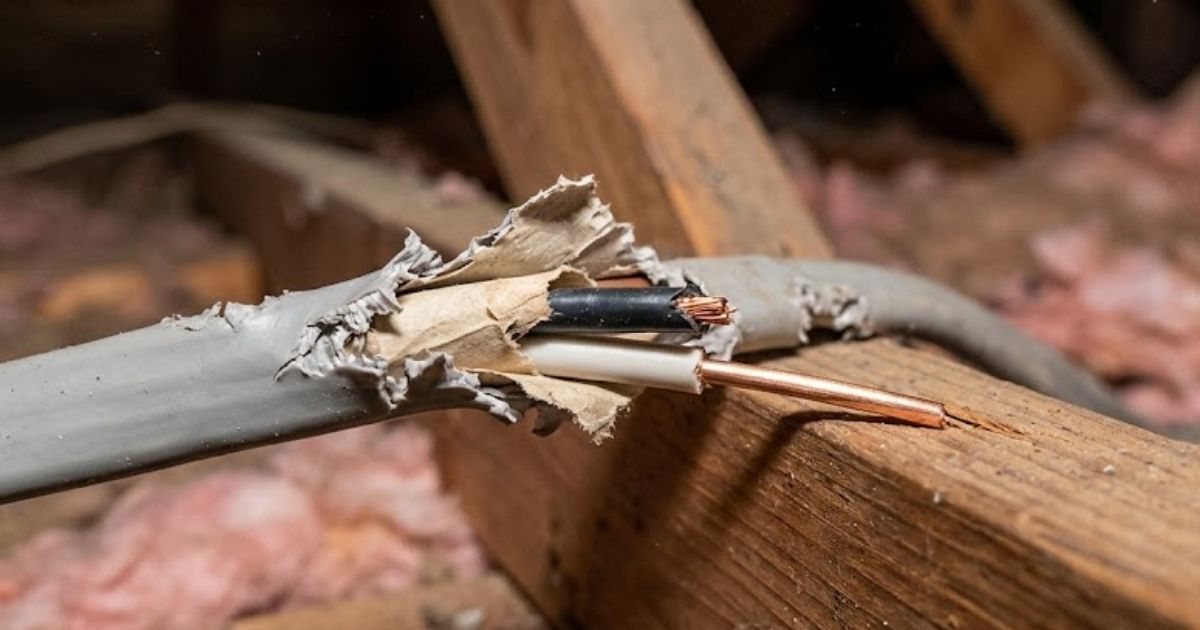
How Rodents Damage Electrical Wiring in Augusta Homes
Of all the structural damage that an untreated rodent infestation causes in an Augusta home, electrical wiring damage is the most dangerous and the most underestimated. Rats and mice gnaw wiring because their incisors grow continuously and must be worn down against hard surfaces. Wiring in attics and wall cavities is conveniently located, the right hardness, and completely invisible to the homeowner until something fails.
Why Gnawed Wiring Is a Fire Hazard
When a rodent gnaws through the insulation jacket of an electrical wire, it exposes the conductor. Exposed conductors in an attic or wall cavity — surrounded by insulation, wood framing, and other combustible materials — are in contact with a fire-starting environment every time the circuit is active. The NFPA has documented rodent gnawing as a significant factor in residential fires attributed to "unknown electrical cause."
Augusta's humid climate adds a secondary mechanism: exposed conductors in a humid attic environment oxidize, increasing resistance and generating localized heat. In a sealed, insulation-surrounded space, that heat accumulates without dissipation — generating enough heat to ignite adjacent insulation over time even without an immediate short circuit.
What Gnawed Wiring Looks Like
- Exposed copper conductor — clean, bright copper visible through gnawed jacket insulation. Fresh gnawing leaves the copper clean; older damage may show green oxidation.
- Missing insulation sections — lengths of wire where the jacket has been completely removed, leaving bare conductor along a rafter.
- Chewed wire ends — where a wire has been gnawed through entirely, typically causing a circuit failure the homeowner notices. The partial-removal case is more dangerous because the circuit continues to function.
- Nesting material packed around wiring — insulation and fabric against active wiring creates fire fuel load immediately adjacent to a potential ignition source.
Roof rats are the primary culprit in Augusta attics: Attic wiring is exactly the right hardness and accessibility for roof rat incisor maintenance. If you have a confirmed roof rat attic infestation, electrical inspection by a licensed electrician is warranted as part of the remediation scope, not an optional add-on.
What to Do If You Find Gnawed Wiring
- Do not ignore gnawed wiring discovered during a rodent inspection or attic walkthrough. It does not self-repair.
- Inform your pest control company — we note all wiring damage observed and include it in the written inspection report.
- Schedule an electrician to assess the extent of damage and replace damaged wiring.
- Do not insulate over gnawed wiring — new insulation will trap heat around a compromised conductor.
- Address rodent removal and exclusion concurrent with or before electrical repair — there is no point in replacing wiring until the gnawing source is eliminated.
Insurance and Documentation
Most standard homeowner's insurance policies exclude rodent damage to the structure itself. Some policies cover resulting damage — notably fire damage caused by gnawed wiring — though this varies significantly by policy. Augusta Rodent Control provides written inspection documentation with photographs of wiring damage for insurance submission and electrician assessment.
Attic Inspection with Wiring Assessment — Same Day Available
We document wiring damage found during inspection. Call now across Augusta and Richmond County.
📞 Call (844) 635-0403Why Rodents Chew Electrical Wiring
The behavior is biological, not pathological. Rodent incisors grow continuously throughout the animal's life — roughly 4-5 inches per year — and require constant grinding to maintain functional length. The animal isn't choosing wires over other materials; it's grinding teeth on whatever materials are available at the harborage location. Electrical wiring, especially the soft plastic and rubber sheathing of modern Romex cable, provides ideal teeth-grinding resistance.
The damage isn't typically intentional or directed. A rodent finds a wire crossing through its travel path or harborage area and grinds against it incidentally during movement. Over weeks of repeated passes, the sheathing wears through and the conductor becomes exposed. From the rodent's perspective, the wire is just one of many surfaces in the environment.
The implications matter for both fire risk assessment and treatment scope. Properties with established colony activity for 3+ months have measurable wire damage probability that newer infestations don't yet present. The longer the activity has been present, the more wire-crossing events have occurred, and the more probable cumulative damage becomes.
Damage Progression and Cost Range
| Stage | Damage Level | Cost Range (Augusta) | Risk Profile |
|---|---|---|---|
| Surface scoring (sheathing visibly damaged but conductor intact) | Minor | $150-450 per repair location | Low immediate fire risk; should be repaired before further damage |
| Sheathing through (conductor exposed) | Moderate | $300-800 per location | Active short-circuit and fire risk; immediate repair warranted |
| Conductor damaged or severed | Major | $500-2,500 per location plus circuit testing | Active fire risk; circuit may need rerunning; electrician required |
| Multiple-location damage across circuits | Comprehensive | $2,000-12,000+ including full inspection and rewiring | Substantial fire risk; often discovered after attic insulation removal during rodent cleanup |
The major-damage scenario — where multi-location wire issues are discovered during contamination cleanup — is more common than most Augusta homeowners assume. We document wiring damage during attic and crawl space inspections and coordinate with licensed electricians for the repair work. The pest control side of the work doesn't include electrical repair; we identify the damage and document its scope so the electrician can quote accurately.
What Prevents Wiring Damage
The single most effective prevention is preventing the rodent activity that produces the damage. Properties with no rodent activity have no wire damage progression. Properties with quick-response treatment of detected activity have minimal damage. Properties with long-established colonies have cumulative damage proportional to the colony duration. Early-stage removal at the first signs of activity is the most cost-effective intervention against electrical damage — the math strongly favors catching colonies at week 6 rather than month 6.
For properties with ongoing rodent pressure — common in older neighborhoods like Harrisburg and Forest Hills, and in rural-edge properties facing continuous outdoor pressure — annual electrical inspection during the pest-control verification visit provides additional protection. The inspection identifies developing damage before it becomes acute fire risk.
For homeowners considering whether to address current rodent activity quickly versus delaying, the wiring-damage calculation is one of the strongest arguments for prompt action. The cost of delay isn't just additional rodent population — it's accumulating wire damage that eventually requires either electrical repair or a fire-risk gamble. Augusta's older housing stock makes this calculation more acute because original wiring has less margin for additional damage.
What Homeowner Insurance Actually Covers
Standard homeowner insurance typically excludes rodent damage as a category, but coverage of secondary damage caused by rodent activity varies by policy. Fire damage resulting from rodent-chewed wiring may be covered under the policy's fire coverage even though the rodent activity itself wasn't covered. Water damage from rodent-chewed plumbing lines may be covered under water damage clauses. The specifics depend on the policy language and the claim documentation.
The practical implication for Augusta homeowners with confirmed wiring damage: document everything before any cleanup or repair, contact your insurance carrier to clarify coverage before committing to repair scope, and coordinate the electrical repair contractor with the insurance process where coverage applies. Our role in this process is identifying and documenting the damage; the insurance and repair coordination happens between you, your carrier, and the licensed electrician.