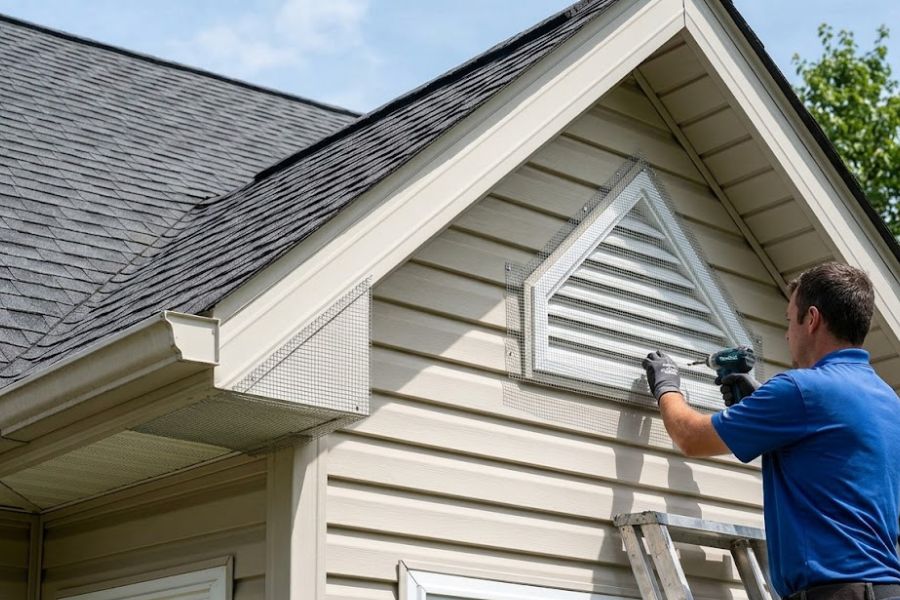
Attic Proofing — Augusta's Roof Rat Problem Starts at the Roofline
Attic rodent proofing addresses the specific entry vectors that roof rats use to access Augusta homes — and it is a different discipline from ground-level exclusion. Roof rats (Rattus rattus) are exceptional climbers that travel overhead, using the live-oak canopy that covers Summerville, Forest Hills, Highland Park, Lake Aumond, Pepperidge, and Sand Hills to reach rooflines without ever touching the ground. Ground-level exclusion alone does nothing to stop them.
The primary entry points for roof rats in Augusta attics are: soffit vent gaps where vent screens have corroded or been pushed in, fascia board separations at roofline corners, gaps around pipe and conduit penetrations through the roof deck, ridge vent gaps, and — critically — any tree branch that touches or overhangs within jumping distance of the roofline. Our attic proofing service addresses every one of these vectors.
The tree-branch issue: Roof rats can jump laterally approximately four feet. Any limb within four feet of your roofline is a potential bridge. We assess branch overhang during every attic proofing job and provide written recommendations for trimming — the trimming itself is outside our scope but is the single most impactful thing most Summerville and Forest Hills homeowners can do to reduce long-term roof rat pressure.
What Attic Rodent Proofing Includes
- Full exterior roofline and attic survey
- Soffit vent screen replacement (hardware cloth)
- Fascia gap sealing (flashing + caulk)
- Ridge vent gap inspection and sealing
- Roof-deck pipe penetration closure
- Gable-end vent screen replacement
- Tree-branch overhang assessment
- Photo documentation of all sealed entry points
- Attic interior confirmation of no remaining activity
- Written entry-point map for your records
Augusta's Canopy Neighborhoods — Highest Roof Rat Attic Risk
Augusta's mature live-oak canopy is one of the city's defining assets — and one of its primary roof rat vectors. The neighborhoods with the highest attic roof-rat pressure are precisely the neighborhoods with the most beautiful tree canopy: Summerville along Walton Way and Milledge Road, Forest Hills, Highland Park, Lake Aumond, Pepperidge, and the larger lots in National Hills. In these neighborhoods, attic proofing is not an optional upgrade — it is the standard preventive treatment for any property where the trees come within branch-jump distance of the roofline.
Trusted CSRA Rodent Specialists
Attic proofing for Augusta's roof-rat pressure. We seal the roofline before the colony establishes — or after removal to prevent re-entry. Call to schedule.
📞 Call (844) 635-0403Augusta Attic Construction Types and Their Rodent Access Patterns
Attic rodent entry varies dramatically by construction era. The same general advice ("seal roofline gaps") plays out very differently on a 1925 bungalow with original cedar-shingle roofing versus a 2018 production home with engineered trusses and ridge-vent ventilation. Knowing which construction type you have helps explain why specific entry points exist on your home and which protocols apply.
Pre-1950 attics typically feature original gable vents (often with degraded screen), no soffit ventilation, plank decking with gaps at panel joints, and roof-penetration plumbing vents that were originally lead-sleeve sealed but have aged. Roof rats access these attics primarily through gable vents and at the rafter-tail terminations where original construction allowed natural ventilation. Olde Town and Harrisburg historic homes fit this profile.
1950s-1970s attics introduced continuous soffit ventilation and ridge venting. The entry points concentrate at soffit terminations (where soffit material has separated from fascia), at gable vent perimeters (where original aluminum frames have shifted), and at HVAC ducting penetrations through the roof deck. National Hills, parts of Forest Hills, and West Augusta neighborhoods cluster in this era.
1980s-2000s attics feature tighter construction with foam-sealed roof penetrations at installation, but the foam degrades within 10–15 years creating new gaps. Soffit ventilation is typically baffled but baffle gaps allow rodent access. Roof-mounted plumbing vent boots crack from UV exposure. Mid-Martinez and the older sections of Evans fit this era.
Post-2000 attics are the tightest baseline construction in Augusta — ridge vents instead of gable vents, foam-spray air sealing, factory-built trusses with no exposed timber. Entry points concentrate at three locations: roof-mounted vent boot cracks, ridge vent terminations at gable ends, and any retrofit penetrations (later solar installation, satellite dish, attic fan). Grovetown subdivisions and newer Evans developments fit this profile.
Cost of Attic Rodent Proofing in Augusta
Attic-specific proofing pricing depends on attic accessibility, roof complexity, and construction era. Steep-pitched two-story roofs in Summerville cost more than single-story ranch attics in Hephzibah simply because the work takes longer and requires more setup.
| Scope | Price Range | Includes |
|---|---|---|
| Attic inspection & assessment | $150–$275 | Full attic and roofline walkthrough, entry-point map, photo documentation, written estimate. |
| Targeted attic proofing (single zone) | $350–$750 | Specific identified entry point: gable vent screening, single soffit termination, or one set of roof penetrations. |
| Comprehensive attic proofing | $700–$1,800 | Full roofline perimeter — soffit, gable, ridge, all roof penetrations. The standard scope for durable results. |
| Attic proofing + insulation replacement | $2,200–$5,500+ | Comprehensive sealing plus removal of contaminated insulation and new R-30 (or higher) installation. |
Insulation replacement is typically warranted when an attic has had 6+ months of established rodent activity, when droppings contamination is significant, or when insulation has compressed below R-19. We quote insulation replacement separately because the variables (existing R-value, attic square footage, target R-value, accessibility for blow-in installation) move the number substantially.
Attic Proofing FAQ
How do I know if roof rats are using my attic?
Scratching sounds in the ceiling at night — particularly concentrated around the eaves — are the primary symptom. Droppings (dark, spindle-shaped, approximately ½ inch long) in the attic, gnaw marks on rafters or HVAC lines, and nesting material (insulation pulled into a pile) are confirming signs. If you hear ceiling activity at night, call us to inspect before the colony grows.
Will attic proofing damage my roof?
No. Our attic proofing methods use hardware cloth mechanically fastened to existing framing, sealants applied to existing surfaces, and screen replacements that fit existing vent frames. We do not modify roofing material, replace shingles, or alter any structural element that would void a roofing warranty.
Can I combine attic proofing with removal?
Yes, and this is the recommended sequence. We confirm the infestation is cleared first, then seal entry points so new rats cannot re-enter. Sealing while an active infestation remains in the attic traps rats inside — creating a dead-rat odor problem on top of the original infestation.
How much does attic proofing cost in Augusta?
Attic proofing for a standard Augusta home typically runs $350–$800, depending on roofline complexity and the number of vent replacements required. Single-story homes with simple rooflines are at the lower end; two-story homes with multiple gable vents, ridge vents, and complex fascia run higher. We quote after the inspection.
How do I know if rodents are actually in my attic?
Three signals together usually confirm activity: scratching or running sounds from the ceiling, particularly at dusk or dawn; visible droppings during a flashlight inspection (mouse droppings ¼" long, rat droppings ¾–1" capsule-shaped); and disturbed insulation showing trails, depressions, or burrow holes. Any one signal alone could be other wildlife (squirrels, opossums); two or more typically confirms rodent activity.
Will sealing the attic trap rodents inside?
Yes if done without first removing them — which is why removal precedes proofing in nearly every case. We typically complete a roof rat removal or comprehensive rodent removal first, verify the attic is clear, then proceed with proofing. Sealing alone on an active infestation creates dead rodents in walls within days.
Do I need new insulation after rodent activity?
Sometimes. Light or recent activity (under 30 days) usually doesn't warrant replacement — surface cleanup and continued monitoring is sufficient. Established activity (months of presence) with visible droppings concentration, urine staining, and nest material typically does warrant partial or full replacement, both for health reasons and because compressed soiled insulation has lost its R-value. The inspection tells us which condition applies.
What about my attic fan or whole-house fan?
Attic fans are a frequent entry point. When inactive, the louvers don't always close fully, and the fan-housing-to-roof transition often has gaps. We address these as part of comprehensive attic proofing — either with screen-mesh inserts behind the louvers or with full housing-perimeter sealing. Whole-house fans (mounted in ceiling between attic and living space) get similar treatment from above.
Can attic work be done in Augusta's summer heat?
Yes but with scheduling adjustments. Attic temperatures in Augusta routinely exceed 130°F in July–August afternoons. We schedule attic-intensive work for early morning (before 10am) during the hottest months. Inspection-only visits can happen at standard hours. For homeowners scheduling discretionary attic work, October-April is the most productive window.
Related Services
Roof Rat Removal
Active roof rat removal from Augusta attics — must precede sealing when an infestation is present.
Attic Cleanup & Sanitization
Post-infestation attic remediation — droppings removal, nest clearing, and HEPA sanitization.
Rodent Exclusion
Full exclusion program — attic proofing plus ground-level sealing for complete protection.