Why Rats Invade Attics in Augusta Neighborhoods
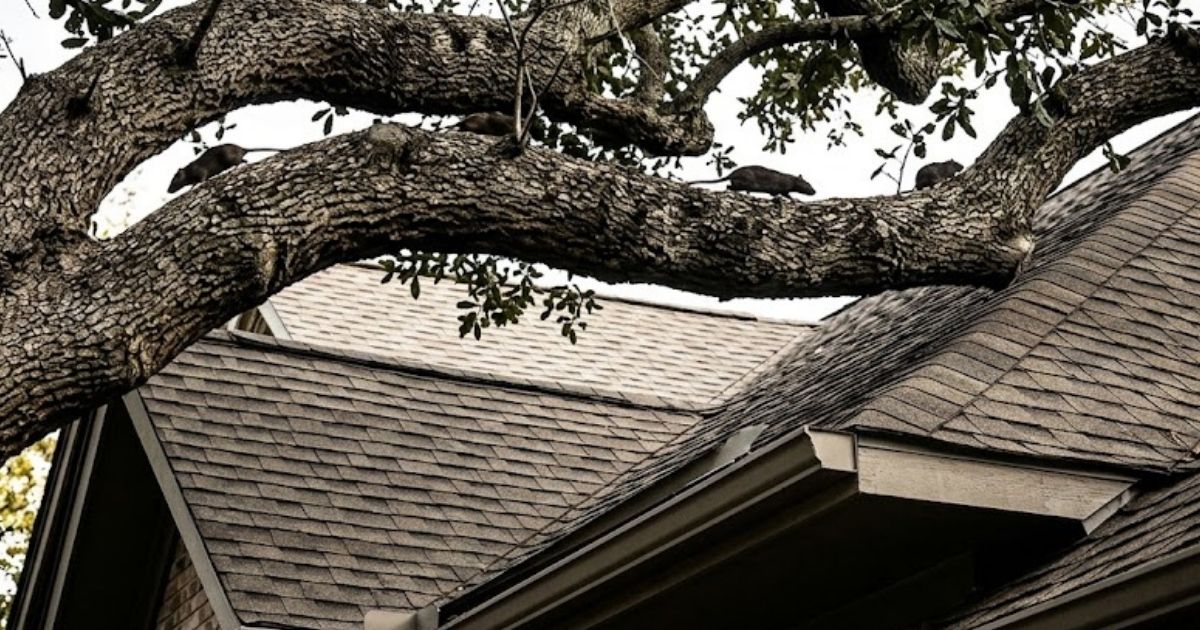
If you live in Summerville, Forest Hills, Highland Park, Lake Aumond, or Pepperidge and you hear scratching in your ceiling at night, the likely culprit is Rattus rattus — the roof rat — and the likely explanation is the tree branch overhanging your roofline. Augusta's attic rat problem is not a function of structural vulnerability alone. It is the product of a specific ecological feature: a mature, continuous live-oak canopy that has been growing, spreading, and overhanging residential rooflines for 50 to 150 years.
How the Live-Oak Canopy Creates a Rat Highway
Roof rats are extraordinary climbers — their long toes and flexible spine allow them to navigate branches with the confidence of a squirrel and the stealth of a cat. They travel overhead rather than at ground level, which is why ground-level exclusion alone does not stop them. A Norway rat burrows under your foundation; a roof rat crosses your oak tree to your fascia board and enters through the corroded soffit vent you didn't know needed replacing.
The mechanism in Augusta's canopy neighborhoods: roof rats nest in tree hollows and dense canopy, then use any branch that comes within approximately four feet of a residential roofline as a bridge. Aging aluminum soffit vents — the kind installed on mid-century Augusta homes in the 1950s and 1960s — corrode and develop gaps that provide easy access. Once inside the attic, the rat finds warm shelter and excellent nesting material in the form of insulation. A pair in the attic in October is a family of 12–20 by February.
Which Augusta Neighborhoods Are Most Exposed
The risk gradient follows the canopy. Summerville along Walton Way, Milledge Road, and Heard Avenue has the oldest and densest live-oak canopy — some trees overhang multiple rooflines simultaneously. Forest Hills and Highland Park have extensive mid-century oak and pine growth with 60–70 years of height. Lake Aumond and Pepperidge have similar canopy depth. Newer subdivisions in Evans, Grovetown, and Martinez — where landscaping was planted 20–30 years ago — see far fewer roof-rat attic infestations.
The four-foot rule: Any tree branch that comes within four feet of your roofline — horizontally, not just directly overhead — is within roof rat jump range. We assess branch clearance at every attic proofing visit and provide written trimming recommendations.
Why Recurring Attic Infestations Happen
The most common reason Augusta homeowners experience recurring attic infestations is treatment without exclusion. Baiting or trapping kills the current colony; the canopy population supplies a new one through the same unsealed entry points within 60–90 days. Permanent resolution requires: removing the active infestation, sealing every confirmed entry point (soffit vents, fascia gaps, pipe penetrations), and assessing branch overhang for trimming. Any two of the three steps produce a temporary result.
What to Do If You Hear Ceiling Activity at Night
- Note where the sound is concentrated — near the eaves, toward the center, or moving linearly. This helps during inspection.
- Do not attempt to seal any openings until an inspection confirms which entry points are active — sealing occupied rats inside creates a dead-rat odor problem.
- Do not place poison bait in the attic yourself — roof rats that die inside wall voids create localized odor problems.
- Call (844) 635-0403 — we offer same-day attic inspections across all Augusta neighborhoods.
Attic Rat Inspection — Same Day Available
Ceiling activity at night? Call now — 24/7 dispatch across Augusta and Richmond County.
📞 Call (844) 635-0403Roof Rat Pathways: How They Actually Get Into Augusta Attics
Roof rats reach attics through specific pathways that homeowners can identify and modify. Understanding the pathways helps both DIY prevention and informed conversations with professional inspectors.
| Pathway | How It Works | Common Augusta Locations |
|---|---|---|
| Tree canopy to fascia | Branches within 4 feet of fascia or roofline create direct bridges; rats walk across | Summerville, Forest Hills, mature blocks of Olde Town |
| Utility wires to soffit | Electrical service, cable, or phone lines provide tightrope access from poles to home | Universal across Augusta; older neighborhoods particularly |
| Climbing exterior wall to roofline | Brick or rough-surface walls allow direct climbing; smooth surfaces don't | Brick-faced homes throughout Augusta, especially Harrisburg and historic blocks |
| Climbing downspouts and gutters | Vertical drainage features provide climbing access; gutter terminations are entry points | Universal; condition of gutter terminations matters |
| Climbing fences to adjacent roof | Fence-line to neighboring structure to roof access | Dense residential blocks across the CSRA |
| Adjacent structure proximity | Detached garage, shed, or porch roof within 3-4 feet of main roof | Older properties throughout Augusta |
The trimming-or-not-trimming question matters because canopy is a real pathway, but it's not the only pathway. Removing canopy alone doesn't address rats accessing via utility wires, brick climbing, or downspout climbing. Comprehensive prevention addresses the pathway that applies to your specific property rather than treating canopy as universal.
What Actually Stops Roof Rats from Entering
Once at the roofline, roof rats enter through specific structural vulnerabilities that aging buildings develop. Sealing these is the work that produces durable results, regardless of which pathway brought the rats to the roof.
The high-priority entry points: gable vents with degraded screens; soffit terminations where soffit has separated from fascia; roof-mounted plumbing vent boots cracked from UV exposure; ridge vent terminations at gable ends; dormer flashing transitions; attic fan housings; roof penetrations for cable, satellite, or solar equipment. Each requires specific exclusion material — see comprehensive exclusion methodology for the materials breakdown.
For Augusta homeowners with mature canopy creating ongoing pathway pressure, the realistic plan combines two work types: structural sealing of attic entry points (the high-priority intervention), plus optional canopy management coordination with tree-care professionals (the secondary intervention that homeowners often have aesthetic preferences about). Both produce more durable results than either alone. Roof rat removal includes the entry-point sealing as part of standard scope; canopy work coordinates separately with tree-care vendors.
The neighborhoods most affected by chronic roof rat pressure in Augusta — Summerville, Forest Hills, Olde Town, parts of Highland Park — share both mature canopy and pre-1980 construction with the roofline vulnerabilities that allow entry once rats reach the roof. The combination is what makes these neighborhoods consistent roof rat hot spots. Properties in newer Columbia County subdivisions face occasional roof rat pressure but typically at much lower frequency because the structural inventory is tighter.
What Augusta Homeowners Should Do First
For Augusta homeowners hearing attic noise, the first practical step is identifying whether the activity is current or historic. Set a small piece of paper or cardboard across a suspected travel path in the attic — if it's moved or disturbed within 48 hours, activity is current. If undisturbed for a week, the noise may be from non-rodent causes (settling, HVAC, wildlife other than rodents). This simple test prevents over-response to non-issues and confirms genuine rodent activity that warrants professional attention.
For confirmed activity, the second step is timing. Current activity in fall (September-November) needs prompt response because of the migration-driven population pressure that compounds quickly. Current activity in spring or summer often allows more flexible scheduling because the seasonal pressure is lower. The urgency calibrates against the season rather than being uniform year-round.