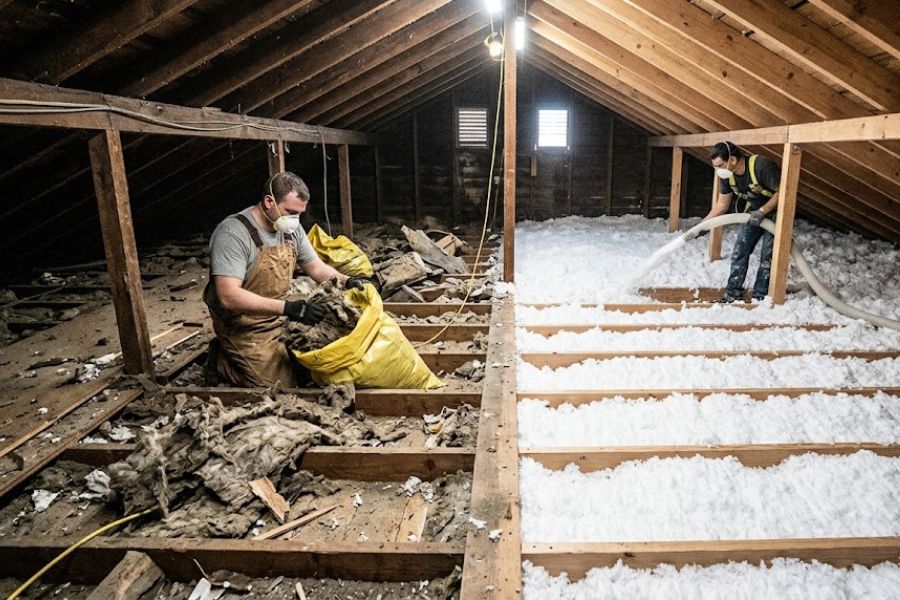
When Insulation Replacement Becomes Necessary After Rodent Damage
Insulation replacement after rodent damage is required when contamination has spread throughout the attic floor — not just in the areas immediately adjacent to nesting sites. Rats and mice urinate continuously as they travel, so a long-established infestation saturates insulation broadly, not just in the nest pile. The urine breaks down into ammonia compounds that off-gas through the ceiling into living spaces and the active pathogen load remains elevated for months in Augusta's humid, warm attic environment.
The practical test for replacement vs. targeted cleanup is the contamination footprint: if droppings are distributed across more than approximately one-third of the attic floor area, full insulation removal is almost always the more cost-effective approach than attempting targeted extraction. Trying to remove individual contaminated sections of batts or blown insulation typically costs more labor than full removal and leaves contaminated material behind.
R-value loss from rodent damage: Beyond contamination, rodents physically degrade insulation. Roof rats compress batts for nesting material, reducing R-value in nesting areas to near zero. Blown cellulose or fiberglass is tunneled through, creating air channels that bypass insulation entirely. Augusta Energy Code requires R-38 minimum for attic insulation — a heavily infested attic can fall significantly below that threshold, increasing cooling costs in Augusta's long, hot summers.
What Insulation Replacement Includes
- Attic contamination assessment and scope confirmation
- Full contaminated insulation removal and bagging
- HEPA vacuuming of exposed attic floor
- Enzyme disinfectant application to decking
- Rodent entry point inspection (exclusion recommended before re-insulation)
- New blown insulation installation to current code
- R-value confirmation and documentation
- Photo documentation before and after
When Insulation Replacement Is Actually Necessary
Insulation replacement is the most expensive component of rodent damage remediation, and it's also the one most likely to be either over-recommended (by contractors looking to upsell) or under-recommended (by homeowners trying to save money). The decision should be based on documented contamination extent and measurable R-value loss, not on aesthetic concerns or worst-case-scenario sales pitches.
Replacement is clearly necessary when: visible droppings are distributed across the majority of attic floor area; urine staining is widespread (visible to UV light inspection); insulation has been mechanically compressed below R-19 by rodent traffic and nesting; or extended rodent activity (6+ months) has occurred with no remediation. In these cases, replacement is the only path to restored R-value and contaminated-free attic conditions.
Replacement is probably necessary when: moderate contamination is spread across multiple zones; nest sites have been identified within insulation (not just on top of it); or contamination cleanup quotes indicate the cleanup cost approaches replacement cost. At that point, replacement gets you a fresh start rather than a marginally improved existing condition.
Replacement is usually not necessary when: contamination is localized to a single area (HEPA vacuum + spot cleanup); rodent activity was brief (under 30 days); insulation is otherwise in good condition with current-spec R-value. Cleaning in place often produces the same end result as replacement for these scenarios at 1/3 the cost.
Augusta-Specific R-Value Requirements and Material Choices
Augusta sits in Climate Zone 3 per the International Energy Conservation Code, which sets the recommended attic insulation level at R-38 to R-60. Older Augusta homes often have R-11 to R-19 in original construction — significantly under current code. Insulation replacement is the natural opportunity to bring R-value up to current standards while doing the work.
| Insulation Type | R-Value per Inch | Best For | Cost (Per Sq Ft) |
|---|---|---|---|
| Blown-in fiberglass | R-2.5 | Most standard attic replacements; easy retrofit | $1.20–$1.80 |
| Blown-in cellulose | R-3.7 | Higher R-value per inch; better for low-clearance attics | $1.40–$2.20 |
| Spray foam (open cell) | R-3.6 | Air-sealing benefit; new construction or major renovation | $1.50–$3.50 |
| Spray foam (closed cell) | R-6.5 | Maximum R per inch; vapor barrier function | $2.50–$5.00 |
Cost of Insulation Replacement After Rodent Damage in Augusta
| Project Scope | Price Range | Includes |
|---|---|---|
| Partial replacement (single zone, under 500 sq ft) | $1,200–$2,500 | Contaminated insulation removal, area sanitization, replacement to current R-value. |
| Standard residential replacement (500-1,200 sq ft) | $2,200–$4,800 | Full attic, blown-in fiberglass or cellulose, comprehensive sanitization. |
| Large home or premium material replacement | $3,800–$7,500+ | Larger attics, spray foam or premium materials, full sealing work. |
| Whole-attic insulation + air sealing + sanitization | $5,500–$12,000+ | Comprehensive thermal upgrade combined with rodent remediation. Often the right scope for older Olde Town and Harrisburg homes with original R-11 insulation and extensive contamination. |
Insulation Replacement FAQ
Does all the insulation have to be removed?
Only if contamination is widespread. Localized nesting with limited droppings spread may only require partial removal. We assess the contamination footprint on-site and give you an honest recommendation — full removal is only recommended when it is genuinely the most effective approach.
What type of insulation do you install after removal?
We typically install blown fiberglass or blown cellulose, depending on the attic structure and the homeowner's preference. Both are appropriate for Augusta's climate. We install to current Georgia Energy Code minimums (R-38 for most Augusta attics) and can go higher on request.
How much does insulation replacement cost in Augusta?
Removal of contaminated insulation typically runs $500–$1,200 for a standard single-family attic, depending on depth and square footage. New blown insulation installation typically runs $1.00–$2.00 per square foot installed to R-38. Combined projects run $1,500–$3,500 for a typical Augusta home. We quote after the inspection.
Should exclusion happen before or after re-insulation?
Exclusion must happen before new insulation is installed. Installing new insulation before sealing entry points means the new insulation will simply be contaminated again by the next infestation. The correct sequence: removal → cleanup → exclusion sealing → new insulation.
Does insurance cover rodent insulation damage?
Most standard homeowner's policies exclude rodent damage. Some policies cover resulting physical damage (e.g., HVAC damage caused by a rodent-caused system failure). We provide written damage documentation and scope records for insurance submission — coverage determination is between you and your insurer.
Does insurance cover insulation replacement after rodent damage?
Standard homeowners insurance typically does not cover rodent damage, including insulation replacement. Some policies cover damage from "vermin" only when caused by a covered peril (fire, water damage, storm) — pure rodent contamination is excluded. Check your policy language for "infestation" or "vermin" exclusions. Some specialty pest-damage riders are available but rare in this market.
Can you tell how much insulation needs to be replaced?
Yes — the assessment uses visible droppings distribution, UV-light urine staining (visible under ultraviolet inspection), insulation density measurements, and R-value testing in suspect areas. We provide a written scope showing the specific zones recommended for replacement versus cleaning in place. The estimate is based on documented contamination, not worst-case assumptions.
Will new insulation prevent future rodent activity?
Insulation itself doesn't prevent rodents — they'll nest in new insulation just as readily as old. Prevention comes from exclusion work that addresses entry points before or during insulation replacement. Doing replacement without exclusion is rebuilding for the next infestation; combining them produces durable results.
Should I replace with the same insulation type or upgrade?
Replacement is the natural opportunity to upgrade R-value to current code (R-38 to R-60 for Augusta), and sometimes to switch materials (fiberglass to cellulose for better R per inch). The upgrade cost is typically 20-40% above like-for-like replacement and produces energy savings that recover the difference within 3-7 years. Most Augusta homeowners choose to upgrade during replacement.
Related Services
Stop the Damage Before It Spreads — Get a Free Inspection
Contaminated insulation removal and replacement for Augusta attics. Call to schedule a damage assessment across Richmond County.
📞 Call (844) 635-0403