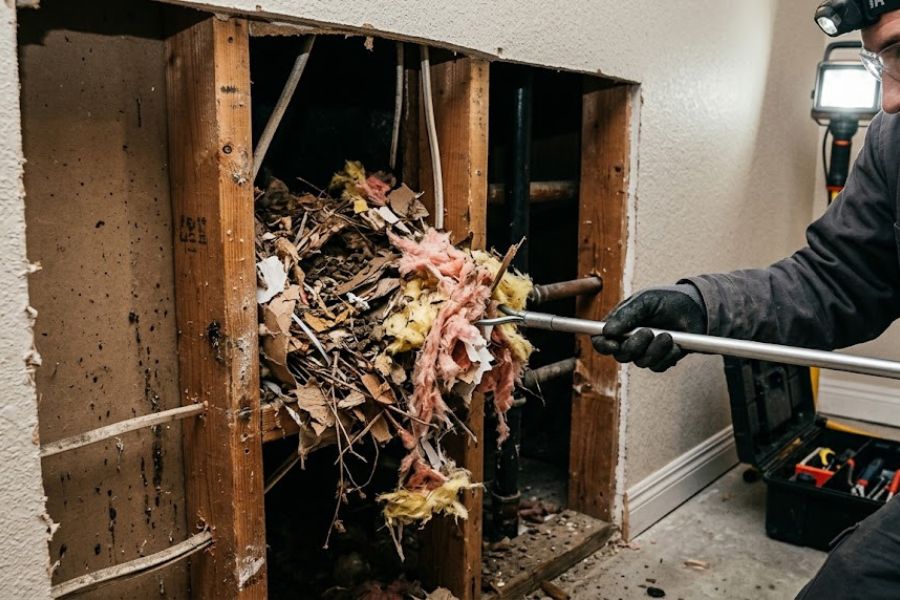
Why Rat Nest Removal Is a Distinct Step — Not Just Part of Cleanup
Rat nest removal is not simply part of general cleanup. Rat nests — dense accumulations of insulation, fabric, plant material, and paper constructed by the resident colony — are saturated with urine, carrying the pheromone markers that signal to other rats that a location is safe, established, and occupied. An attic where the nest material remains after removal will attract new rats to the exact same location within weeks, even if every entry point has been sealed. The pheromone signal is strong enough to draw rodents through newly sealed gaps they would otherwise never investigate.
Augusta Rodent Control removes nest material completely — not spot-treating or deodorizing in place — and applies enzyme disinfectant to the surrounding area to break down the pheromone compounds. This step is particularly important in roof-rat attic infestations in Summerville, Forest Hills, and Highland Park, where the live-oak canopy means new rats are always within access distance of your roofline. A re-attraction nest left in place in these neighborhoods is a near-certain guarantee of re-infestation.
Nest locations in Augusta properties: Roof rat nests are typically found in attic insulation, between rafters, inside wall cavities accessed from the attic, and occasionally in soffit spaces. Norway rat nests are found in crawl spaces near the warm base of walls, under vapor barriers, and occasionally in wall voids at ground-floor level. House mouse nests appear in kitchen cabinet insulation, behind appliances, and in stored materials anywhere in the structure.
What Rat Nest Removal Includes
- Nest location and full extent assessment
- Pre-treatment enzyme disinfectant application
- Complete nest material removal (no in-place treatment)
- Double-bag disposal of all contaminated material
- Surrounding area disinfection
- Insulation damage assessment (replacement quoted separately)
- Pheromone neutralizer application to substrate
- Photo documentation before and after
What a Rat Nest Actually Looks Like in Augusta Properties
Rat nests rarely look like the cartoon image homeowners have in mind. They aren't tidy bowls of organized material; they're loose collections of shredded fiber compressed into wall voids, attic insulation pockets, or crawl space corners — often spread across a larger area than expected. Recognizing what a nest looks like in your specific property type helps both with DIY identification and with knowing when professional removal makes sense.
Norway rat nests (ground-level structures) typically appear in crawl spaces, behind appliances in garages, inside outbuildings, and at foundation-adjacent storage areas. Materials lean toward dense fiber — shredded cardboard, insulation batting, plant material from outdoor sources. A mature Norway rat nest can occupy 1-3 cubic feet of compressed material.
Roof rat nests (elevated structures) appear in attic insulation, soffit cavities, and behind structural elements at the roofline. Materials lean toward lighter fibers — fiberglass insulation, shredded paper from attic storage, fabric from stored items. Roof rat nests are typically spread across a larger area than Norway rat nests because the species moves through the structure more.
Both species create satellite nesting sites — secondary, less-developed collections in adjacent voids — once population grows. A property with one visible nest typically has 2-4 secondary nesting sites that aren't immediately visible. Comprehensive nest removal addresses all of them, not just the obvious one.
Cost of Rat Nest Removal in Augusta
| Scope | Price Range | Includes |
|---|---|---|
| Single accessible nest removal | $175–$350 | One nest in accessible location (visible attic, crawl space corner, garage). Removal, contaminated material disposal, area cleanup. |
| Multi-site nest removal (single property) | $400–$900 | Multiple nests across attic and crawl space. Includes thorough inspection to locate satellite sites. |
| Nest removal + sanitization | $550–$1,400 | Full removal plus HEPA cleanup and surface disinfection of affected areas. |
| Nest removal + insulation replacement | $1,500–$4,500+ | Where nesting has compromised attic insulation, often the case after months of activity. See insulation replacement. |
Wall-void nest removal — when nests are inside finished walls rather than in accessible cavities — runs higher within these ranges because each nest requires drywall access. We make patch-ready openings and document each location to support whatever wall restoration follows.
Rat Nest Removal FAQ
Why can't I just remove the nest myself?
You can, with proper PPE — N95 or better respirator, gloves, and a Tyvek suit for enclosed spaces. The risk is aerosolizing hantavirus particles during disturbance of dried nest material. For attic work especially, the enclosed space and overhead activity increase exposure risk significantly compared to ground-level cleanup. Professional removal with HEPA equipment and proper disinfectant protocol eliminates that risk.
How do I know if a rat nest is active or abandoned?
Active nests have fresh droppings (dark, moist) adjacent to the nest material, fresh gnaw marks nearby, and smell strongly of ammonia (fresh urine). Abandoned nests have dry, grey droppings, no fresh gnaw activity, and the material is typically dusty and compressed. We assess activity status during inspection before deciding on treatment sequence.
Should nest removal happen before or after exclusion?
After full removal is confirmed — and before exclusion. The sequence: active rat removal, activity confirmation (no new droppings over 72 hours), nest removal and disinfection, then exclusion sealing. Sealing before nest removal leaves the pheromone signal inside a structure that is now accessible only from outside — which does reduce re-entry risk somewhat, but is not as effective as full removal before sealing.
How much does rat nest removal cost in Augusta?
Small accessible nest removal (single location, easy attic or crawl access) typically runs $150–$350. Multi-nest or large attic infestations where nesting is distributed across the space run $350–$800 and are usually combined with full attic cleanup. We quote after inspection.
Should I remove a rat nest myself?
For small accessible nests in non-confined spaces (garage corner, outdoor shed), DIY with proper PPE is feasible. Wear N95 mask and gloves, wet the material with disinfectant before disturbing, double-bag for disposal. For attic or crawl space nests with extensive contamination, professional removal is safer because the work involves contaminated insulation handling and confined-space exposure that household PPE doesn't fully address.
Can rats reuse a nest after I remove it?
The same physical location, occasionally yes — if the structural conditions that supported the original nest haven't changed, the same area is attractive to subsequent rats. Removal of the nest itself doesn't prevent recurrence; addressing entry points and harborage conditions does. Most comprehensive rat work combines nest removal with rat proofing to prevent the cycle.
What about the smell after nest removal?
Active nest material often carries the smell of decomposition (dead nestlings or adults that died in place) plus urine concentration. Removal eliminates the source; sanitization of surrounding surfaces eliminates the residual. Most properties report odor resolution within 24-48 hours of comprehensive removal plus enzymatic treatment.
Will removing the nest also remove the rats?
Not directly. Rats abandoned the nest at some point before discovery in most cases. If an active colony is still using the location, nest removal during their absence is part of the work but doesn't substitute for population removal. Complete service combines rat control with nest removal and exclusion to fully resolve the situation.
Can you remove a nest without disturbing my insulation too much?
If the nest is in attic insulation but contamination is localized, we can typically remove the nest material and a 2-3 foot perimeter of affected insulation without disturbing the larger attic. Where the nest sits inside a wall cavity, minimum-disturbance access (single 4-inch drywall opening) usually suffices. Larger removal becomes necessary only when contamination has spread beyond a localized zone — which the inspection identifies before work begins.
Related Services
Stop the Damage Before It Spreads — Get a Free Inspection
Rat nest removal and disinfection for Augusta attics, crawl spaces, and wall voids. Call to confirm same-day availability across Richmond County.
📞 Call (844) 635-0403