Mice and Rats in Augusta Crawl Spaces and Basements
If your Augusta home was built before 1975, the crawl space underneath it is almost certainly one of the most rodent-vulnerable parts of the structure — and it may have been for years without anyone knowing. Crawl-space infestations are silent and invisible from the living area until they are substantial, which is why they are typically discovered at a home inspection, during a plumber's visit below the floor, or when a homeowner finally opens the access hatch for the first time in years.
Why Augusta Crawl Spaces Are Particularly Vulnerable
Augusta's older housing was built on raised foundations — brick-pier systems common from the 1870s through 1930s (concentrated in Harrisburg, Olde Town, and Summerville), and concrete block systems from the 1940s through 1970s (throughout Barton Chapel, Bethlehem, Southside, and Sand Hills). Both types were designed for ventilation, not rodent exclusion, and both degrade in ways that create Norway rat and mouse entry points over time.
Brick-pier foundations settle over 100+ years and mortar joints open to gaps Norway rats can access freely. Crawl-space vent screens from the 1950s and 1960s corrode in Augusta's humid environment. The result is a below-grade space that is functionally accessible from the exterior through multiple points regardless of above-grade maintenance.
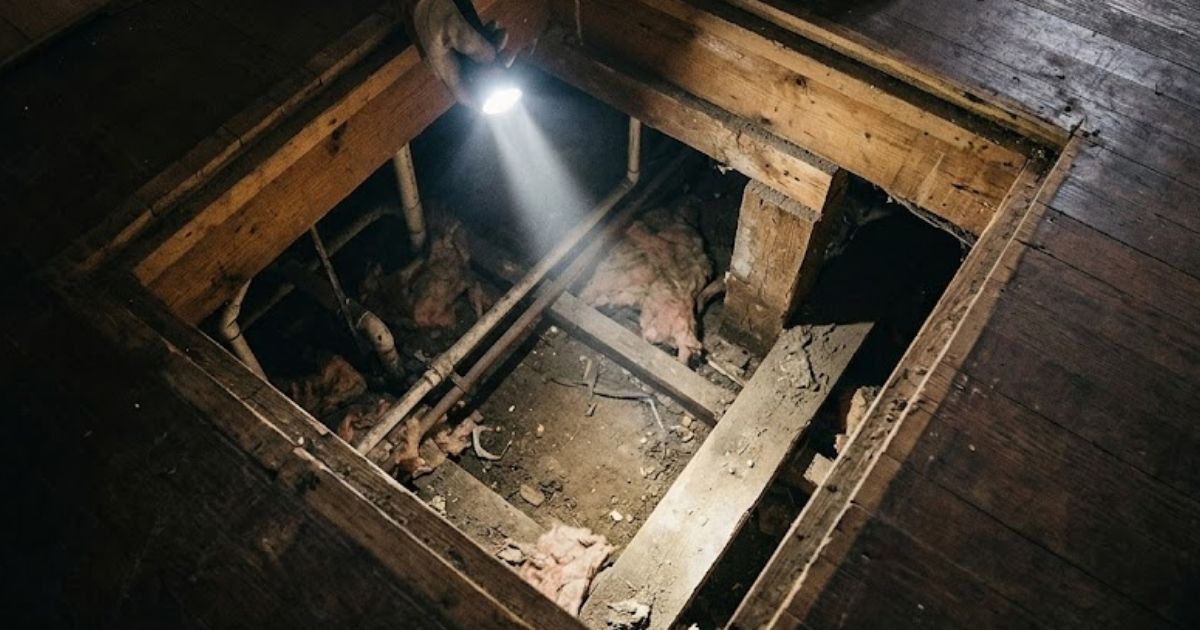
What You Find in a Rodent-Infested Crawl Space
- Norway rat droppings along the perimeter wall base and near utility runs — ¾ inch, blunt-ended, dark and moist when fresh
- Burrow openings in soil adjacent to foundation piers, often with fresh soil excavated around the entry
- Nesting material accumulated against warm wall bases — insulation pulled from nearby pipe wrap, fabric, plant material
- Gnaw marks on floor joists and subfloor near wiring and piping travel routes
- Ammonia odor detectable from the living area in well-established infestations, particularly in summer
The moisture connection: Augusta's humid climate creates a dual problem in crawl spaces — rodents and moisture damage often coexist, and each makes the other worse. If you find rodent evidence in your crawl space, a moisture assessment is warranted alongside the pest inspection.
Crawl Space vs. Basement — What Augusta Has
True full-depth basements are uncommon in Augusta — the water table and clay soil make basement construction more expensive. What Augusta homes with "basements" typically have are partial below-grade utility rooms that communicate with a crawl space. The exclusion priority is always the crawl-space perimeter, not the interior utility room.
The Exclusion Sequence for Augusta Crawl Spaces
- Inspection and documentation: Every vent opening, pier gap, utility penetration, and access door assessed and photographed.
- Active infestation removal: Confirm the population is cleared before sealing. Sealing while rats are active traps them inside.
- Entry-point sealing: Hardware cloth over corroded vent frames; steel wool packed into mortar gaps; caulk at utility penetrations below grade.
- Contaminated material removal: Droppings, nesting material, and damaged vapor barrier sections removed with hantavirus-safe protocol.
- Follow-up inspection: 2–4 weeks after sealing confirms no new activity and identifies any missed entry points.
Crawl Space Rodent Inspection — Same Day Available
Augusta's older housing stock experts. Written report with photo documentation across Richmond County.
📞 Call (844) 635-0403Augusta Crawl Space Construction Era and Rodent Vulnerability
Crawl spaces are the single highest-volume rodent entry zone in Augusta's pre-1990 housing stock, and the specific entry patterns vary by construction era. Understanding which era your property fits helps explain both why the activity is happening and what the right scope of work looks like.
| Construction Era | Typical Crawl Space Configuration | Primary Entry Points | Treatment Emphasis |
|---|---|---|---|
| Pre-1940 | Brick-pier or raised-pier foundation, open perimeter, unscreened | Continuous foundation perimeter; original sealing absent | Full perimeter screening; preservation-grade materials in historic districts |
| 1940s-1970s | Concrete block foundation with rectangular vent openings every 8-12 feet | Corroded vent screens; aged utility penetrations | Vent screen replacement; targeted penetration sealing |
| 1980s-2000s | Block foundation with partial vapor barrier; improved venting | Aged HVAC penetrations; band-joist gaps | Penetration sealing; HVAC-line-set work |
| Post-2000 (encapsulated) | Sealed vapor barrier system; conditioned air supply | Encapsulation termination points; access door gaps | Termination repair; specialty work |
Augusta basements (true full basements, not crawl spaces) are uncommon outside historic neighborhoods because the high water table in much of the area makes basement construction impractical. Where basements exist — primarily in older Olde Town and Harrisburg properties — they face their own entry-point patterns: original foundation drains, utility tunnels, and the often-overlooked gap where the basement ceiling meets the floor joists above.
Why Crawl Space Treatment Order Matters
For Augusta properties with both crawl space rodent activity and structural moisture issues, the work needs to happen in the right sequence. Sealing a crawl space against rodents without addressing moisture creates a different problem — trapped moisture leads to wood decay, mold, and structural damage that can cost more than the original rodent issue.
The correct sequence is moisture management first (drainage, vapor barrier, ventilation correction), then rodent exclusion. Crawl space rodent sealing happens after moisture conditions are stable. We coordinate with whatever moisture-control or foundation contractor you've engaged for the moisture work; our scope begins after their work concludes.
For Augusta crawl spaces requiring active rodent removal alongside sealing — which describes most calls we receive — the work sequence is: active removal first, verification visit at 7-10 days, comprehensive sealing within 2-3 weeks. The interval matters because sealing while rodents are still active produces the dead-rodent-in-wall scenarios that nobody wants. Properties in neighborhoods like Sand Hills, Bethlehem, and Barton Chapel — where mid-century crawl-space construction dominates — typically need this combined scope.
Why Crawl Space Issues Compound Over Time
The cost differential between catching crawl space issues early versus addressing them after extended activity is substantial. Stage 1 crawl space activity (recent intrusion, isolated nesting site, minimal contamination) resolves with $500-1,000 typical scope. Stage 4 crawl space activity (months of established colony, widespread droppings, compromised insulation, potential structural damage) often requires $2,500-6,000 comprehensive scope plus follow-up work. The math strongly favors prompt response.
For Augusta homeowners discovering crawl space activity during routine maintenance or HVAC service, the assessment matters more than immediate treatment. Professional inspection identifies severity stage accurately and produces a documented scope that homeowners can use to plan treatment timing and budgeting. The inspection report is yours regardless of whether you proceed with treatment immediately.
What Crawl Space Treatment Doesn't Do
Comprehensive crawl space rodent treatment addresses the rodent issue but doesn't substitute for structural moisture or foundation work that may need separate attention. Properties with moisture problems, foundation settling, or HVAC ducting issues need those addressed by appropriate contractors — our work focuses on the rodent component. Coordinating with moisture-control or foundation specialists is part of comprehensive property maintenance for older Augusta homes.
For Augusta homeowners scheduling crawl space inspection or treatment work, fall through spring is the comfortable working window — summer crawl space conditions are harder on the technicians and slower in execution.